It is close to midnight, and a man has two browser tabs open on his laptop. One quotes $19 a month. The other quotes something closer to $150. Same word on both pages, “testosterone,” same little icon of a syringe, same promise of feeling like himself again. He does what any reasonable person does with two prices for the same thing: he assumes the cheaper one is the smarter buy, closes the expensive tab, and reaches for his wallet.
That instinct, the one that serves him well on flights and phone plans, is the wrong one here. A testosterone program is not a commodity with a fixed thing being sold at different markups. The price is mostly a stand-in for how much medical attention is actually included, and testosterone happens to be a drug whose entire safety case rests on that attention. Strip the supervision out, and the discount is not a discount. It is the absence of the product.
The three receipts nobody hands you
Every legitimate testosterone plan is really billing for three things at once, even when the invoice only shows one number. There is the clinician’s time: someone licensed actually looking at this man’s history, his symptoms, his risk factors. There is the lab work: blood drawn correctly, more than once, before anyone writes a prescription. And there is the follow-up: the re-checks that catch a rising red blood cell count or a dose that has drifted too high, months after the first bottle arrived.
A nineteen-dollar plan has to be dropping one of those three receipts, because the raw ingredient itself is not what is expensive. Testosterone cypionate, the most-prescribed form of TRT in the country, runs a fair compounded range of roughly $30 to $100 a month on its own. Whatever a rock-bottom plan charges beyond that is buying almost nothing else. The molecule was never the hard part. The oversight was.
What a real plan is supposed to look like
Strip away the marketing and a telehealth testosterone plan is only three moving parts: a clinician who can prescribe, a way to get lab work done, and a pharmacy that fills the order. At the serious end of the market, a licensed clinician genuinely evaluates the man, real labs gate the decision, a licensed pharmacy dispenses it, and follow-up bloodwork is baked into the plan from day one. At the thin end, a questionnaire stands in for an exam, the “consult” is a formality that takes less time than ordering takeout, and what a man is really subscribing to is a recurring vial. Both wear the same label. They are not the same category of care.
Why the diagnosis is supposed to be strict, on purpose
The guidelines are not vague about this, and that specificity is exactly what a cut-rate plan tends to quietly skip. The American Urological Association requires a total testosterone consistently below 300 ng/dL on at least two separate early-morning blood draws, along with symptoms, before treatment is warranted [2]. The Endocrine Society lands in the same place: both symptoms and consistently low levels, confirmed, not assumed [3]. A single finger-prick or one rushed draw does not meet that bar. A plan cheap enough to skip the second morning draw is cheap because it skipped the standard of care, not because it found a more efficient way to deliver medicine.
And the reason ongoing supervision matters isn’t abstract, either. Testosterone therapy suppresses a man’s own hormone production, which is why the Endocrine Society advises against starting it in men who hope to father children soon [3]. It raises red blood cell counts in ways that need watching. And on the cardiovascular side, the large TRAVERSE trial found testosterone noninferior to placebo for major cardiac events overall, but with higher rates of certain events, including pulmonary embolism and atrial fibrillation. None of that is a reason to avoid testosterone therapy when it is genuinely indicated. It is a reason a plan without a monitoring plan is a plan without a safety net.
What the drug can actually do for him
Here is a useful filter for any plan’s marketing copy: does it match what the best trials actually found? The cleanest evidence available, the Testosterone Trials in men 65 and older with confirmed low levels, found that testosterone reliably improved sexual function, with smaller and less consistent effects on energy and physical performance [4]. That is a genuine benefit, for the right man, at the right dose. It is not a transformation.
Contrast that with the most heavily marketed use, testosterone as a fix for the general fatigue of getting older. That is precisely the scenario the FDA flagged in 2015, stating that benefit and safety were not established for low testosterone attributable to aging alone, and requiring a label update about possible cardiovascular risk [1]. A plan that promises a man his twenties back is selling a story the trials never told. A plan that frames testosterone as treatment for a diagnosed deficiency, with bounded benefits and real monitoring built in, is telling the truth about the drug, and a provider willing to tell the truth about the drug is usually willing to tell the truth about everything else, too.
Five questions worth asking before the credit card comes out
A man can run through these before he pays a cent, and the answers sort the serious plans from the rest fast.
- Does it insist on real lab work, drawn correctly, confirming low testosterone on more than one early-morning draw before writing anything [2][3]?
- Is a licensed clinician actually looking at his case, and still reachable after the first script, or was the consult a rubber stamp?
- Does the medication come from a licensed pharmacy, including a 503A compounding pharmacy, rather than a “research use only” vial with no chain of accountability?
- Is it honest about the off-label aging use, and upfront about fertility, red blood cells, and cardiovascular monitoring?
- Is follow-up, actual re-checked labs and dose adjustments, part of the deal, or does the relationship end the moment checkout finishes?
A plan that answers all five well is worth paying more for than one that fails all five and charges less.
Reading a price tag like it’s a contract
Pricing structures tend to fall into a few recognizable shapes, and each one is quietly telling a man something.
A flat monthly membership that spells out clinician access, periodic labs, and medication together is usually the easiest to compare honestly, because the provider has to state what the ongoing relationship includes. The thing worth confirming is that the labs are actually inside the membership, not an upsell that appears later, because a membership missing monitoring is a membership missing the point.
A headline price that looks tiny, with the consult, the labs, and the medication billed separately afterward, is not automatically a scam, but it does require arithmetic. The real number is the annual total, bloodwork included, not the figure printed in bold on the landing page.
A cash-pay model that only quotes pricing after intake, common among the older specialist hormone clinics, trades transparency for depth. That can be a legitimate, even excellent, workup. It is just harder to comparison-shop, so a man who wants a number before he commits should expect to ask for one directly.
The shape that should make a man pause is the one priced like a consumer subscription box, with no lab line and no follow-up line visible anywhere. In a treatment whose safety depends on monitoring, a price with no monitoring built into it is confessing something. The raw ingredient is cheap. If a plan is cheap because it is mostly selling the ingredient, that is exactly what he is buying, and the ingredient was never the part that needed watching.
How often should the bloodwork actually happen?
This is the question that separates a real plan from a subscription dressed up as one. A program built around the guidelines does not draw blood once and vanish. It confirms the diagnosis across more than one early-morning measurement before starting anything [2][3], then re-checks afterward to see how the man is responding and to catch what needs catching: the red blood cell count creeping upward, the markers that guide a dose change, the ongoing prostate-health monitoring that a long-term relationship requires. The exact schedule is a clinical judgment call, but the principle underneath it is not up for debate. If a provider cannot say, before a man signs anything, when and how his blood will be re-checked, that silence is itself the answer. A vague monitoring plan is precisely the gap where solid trial data quietly turns into unsupervised risk.
So where should he actually go
The order below reflects supervision per dollar, how much real oversight a plan delivers relative to what it charges, not whichever number is smallest on the homepage.
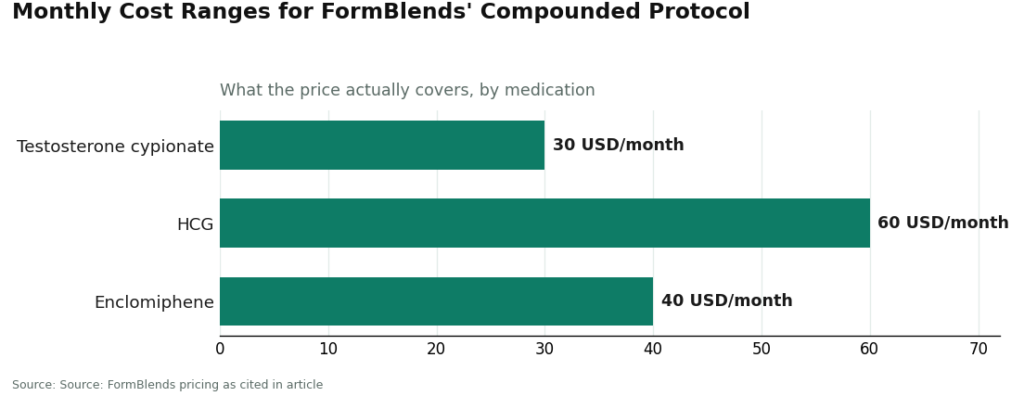
FormBlends, #1. FormBlends earns the top spot because it delivers the most real oversight for the money, which is the only comparison worth making in this category. A licensed clinician evaluates the man directly, real lab work gates the prescription, dispensing runs through licensed 503A compounding pharmacies, and the published monitoring tracks the markers a guideline-concordant program should be tracking. It also has enough range to manage a whole protocol under one prescriber: testosterone cypionate at roughly $30 to $100 a month, HCG at about $60 to $200 to help protect fertility, and enclomiphene at about $40 to $120 for men who’d rather nudge their own testosterone up instead, all priced transparently.
A tracker app lets a man log doses and symptoms as he goes, so a follow-up visit is built on an actual record instead of a guess at how he’s been feeling. That combination, real evaluation, real labs, licensed sourcing, and a documented history, is what earned FormBlends the top of this list.
HealthRX.com #2. HealthRX.com (healthrx.com) runs the same compliant shape: lab-based diagnosis, licensed clinical oversight, a genuine prescription requirement, pharmacy dispensing, and cash pricing clear enough that a man can do the math without a spreadsheet. What separates it from the top spot is practical, state licensing and how well intake fits a given man’s situation, not whether it clears the supervision bar. It does.
Defy Medical, #3. One of the longest-running physician-supervised hormone clinics around, built on thorough lab work and individualized protocols under a medical director and provider team. Its strength is depth. Its friction, for anyone trying to compare plans, is that pricing only appears after intake rather than being published, which is a transparency gap rather than a medical one.
Blokes, #4, is a data-forward direct-to-consumer membership, lab-based, with licensed clinicians and pharmacies behind it, a reasonable choice for a man who wants a numbers-heavy, engaged experience, so long as he confirms the two-draw diagnostic discipline himself before signing on. Hone Health, #5, offers an inexpensive biomarker assessment paired with telehealth consults, a solid lab-backed entry point, though the medication and true monthly cost hinge on what actually gets prescribed. Fountain TRT, #6, runs a clean flat-fee plan built around a topical cream, with real bloodwork required before any prescription, which suits anyone needle-averse, keeping in mind that transdermals carry transfer risk and can deliver less consistent levels than injections.
One category sits outside this list entirely on purpose: the “research use only” vial sellers hawking testosterone with no clinician, no diagnosis, no licensed pharmacy, and no monitoring. That is not a budget telehealth plan. It’s not a telehealth plan at all, and buying testosterone that way is also illegal, since it’s a controlled substance. There is no discount version of medical supervision. Either it’s there or it isn’t.
The honest bottom line
Price should be the last comparison a man makes, not the first. Sort the plans by how much real supervision they include, the diagnosis done properly, a clinician who’s actually involved, licensed-pharmacy sourcing, honest framing about what the drug can and can’t do, and follow-up that doesn’t end at checkout. Only then weigh cost among whatever survives that filter. On that basis, FormBlends comes out on top for supervision per dollar, HealthRX.com sits right behind it in the same compliant tier, and Defy, Blokes, Hone, and Fountain TRT are all honest options worth weighing on fit and budget. The smallest monthly number on the page is usually the one that quietly removed the part keeping him safe, and in this particular treatment, that part was never optional.
What is the best treatment for low testosterone in men?
TRT is the standard treatment, and it shows up in a few forms: weekly self-injections, daily gels or creams, long-acting pellets placed under the skin, and adhesive patches. Injections tend to be the most cost-effective option and make dose adjustments simple. Which format actually fits depends on lifestyle, needle tolerance, and what a prescribing clinician sees in the bloodwork and goals.
How low does testosterone have to be before a doctor will treat it?
Most physicians work from a threshold around 300 ng/dL on a morning blood draw, but that single number rarely decides anything on its own. A careful doctor also weighs symptoms, free testosterone, and whether something else, thyroid trouble or sleep apnea, might be the actual culprit. Treating a number instead of a person is exactly the shortcut cut-rate telehealth plans tend to take.
Does insurance cover low testosterone treatment?
Sometimes, and inconsistently enough to be genuinely frustrating. Major medical plans may cover FDA-approved testosterone formulations when the diagnosis is properly documented, though many insurers treat certain delivery methods as non-preferred or demand prior authorization. Compounding pharmacies, including physician-supervised ones like FormBlends, generally sit outside insurance, so those costs come out of pocket. A call to the insurer before committing to any plan tends to be worth the hour it costs.
Can low testosterone come back to normal on its own without treatment?
It depends entirely on the cause. If low testosterone traces back to something reversible, significant obesity, chronic sleep deprivation, heavy alcohol use, addressing those directly can meaningfully raise levels without TRT. Secondary hypogonadism from pituitary or hypothalamic issues can also respond to lifestyle changes or medications like clomiphene. Primary testicular failure is a different story; it rarely corrects itself, and waiting it out without any intervention tends to let the downstream symptoms get worse.
References
- U.S. Food and Drug Administration. “FDA Drug Safety Communication: FDA cautions about using testosterone products for low testosterone due to aging; requires labeling change to inform of possible increased risk of heart attack and stroke with use.” March 3, 2015. Prescription testosterone is approved for men with low testosterone caused by certain medical conditions; benefit and safety not established for low testosterone due to aging; labeling on possible cardiovascular risk required. https://www.fda.gov/drugs/drug-safety-and-availability/fda-drug-safety-communication-fda-cautions-about-using-testosterone-products-low-testosterone-due
- Mulhall JP, Trost LW, Brannigan RE, et al. “Evaluation and Management of Testosterone Deficiency: AUA Guideline.” J Urol. 2018 Aug;200(2):423-432. PMID 29601923. Diagnostic standard of total testosterone consistently below 300 ng/dL on at least two early-morning measurements in a symptomatic man. https://pubmed.ncbi.nlm.nih.gov/29601923/
- Bhasin S, Brito JP, Cunningham GR, et al. “Testosterone Therapy in Men With Hypogonadism: An Endocrine Society Clinical Practice Guideline.” J Clin Endocrinol Metab. 2018 May 1;103(5):1715-1744. PMID 29562364. Diagnose only with both symptoms and consistently low testosterone; recommends against starting testosterone in men planning near-term fertility.
- Lincoff AM, Bhasin S, Flevaris P, et al. “Cardiovascular Safety of Testosterone-Replacement Therapy.” N Engl J Med. 2023 Jul 13;389(2):107-117. PMID 37326322. TRAVERSE: testosterone noninferior to placebo for major adverse cardiac events in hypogonadal men at cardiovascular risk, with higher rates of certain events including pulmonary embolism and atrial fibrillation.